

Before I had said a word
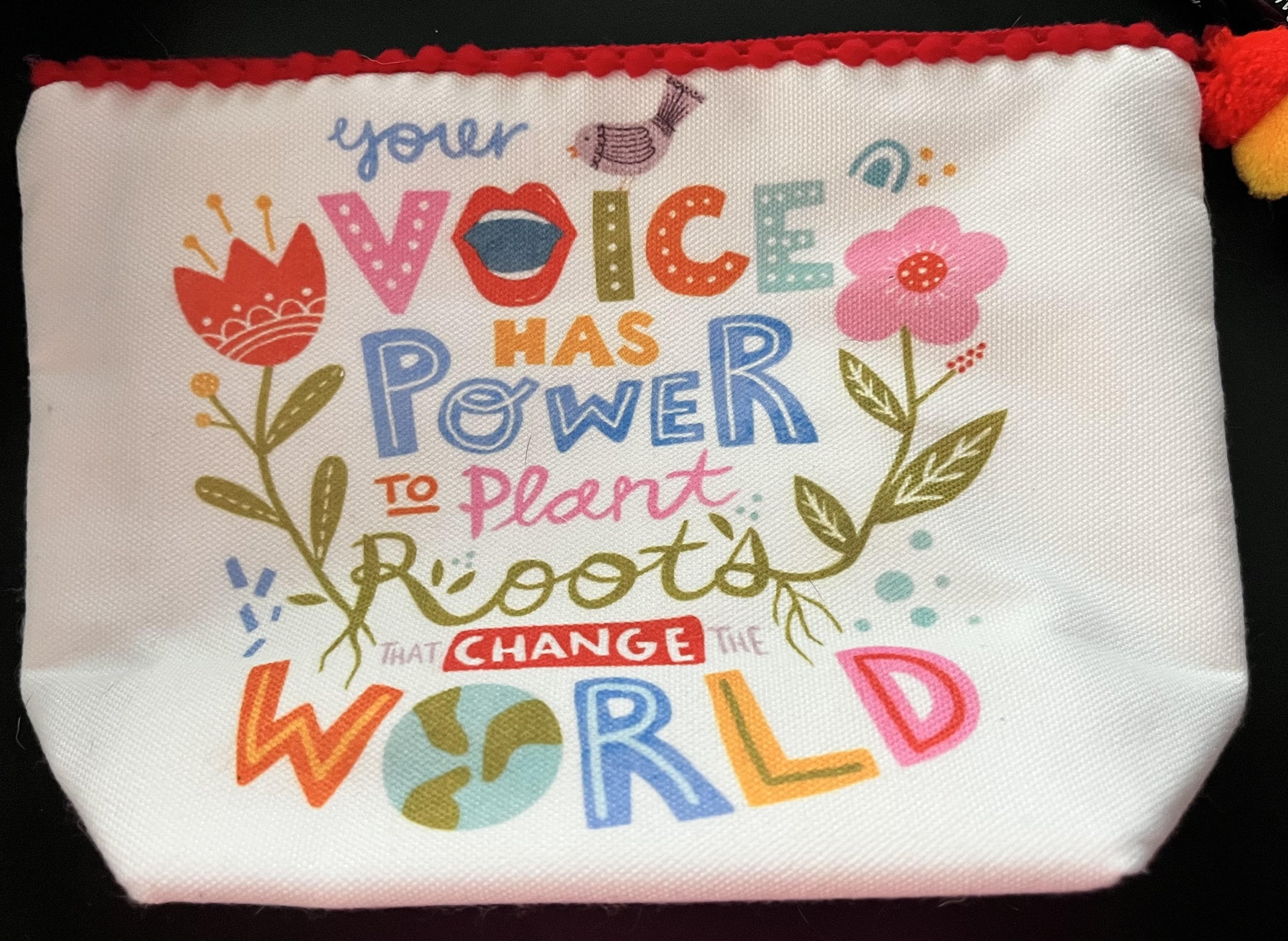
One of my supervisors gave me a gift on my first day of work. A small canvas pouch, hand-lettered across the front: your voice has power to plant roots that change the world.
First day. Before I had said anything in that building. Before I knew where anything was, or who decided what, or which concerns went somewhere and which ones went nowhere. She had no way of knowing yet whether my voice was worth anything, and she handed me that sentence anyway.
It was a kind thing to do, and it was meant with the best intentions and I appreciated it. I want to be clear about that, because what I have to say next is not about her.
Nursing has a great deal to say about voice
We are taught to speak up. It is in our code of ethics, our orientation modules, our annual competencies, our just culture posters. See something, say something. Escalate. Stop the line. Your voice matters.
The research on what actually happens when we do is less inspirational.
Nurses who spoke up during the pandemic — about protective equipment, about patient safety, about redeployment — described meeting what the researchers called a deaf or hostile response, and coming away feeling disregarded by their own organizations (Abrams and colleagues, Journal of Advanced Nursing, 2023). Not opposed. Disregarded. Anyone who has lived it knows which of those is worse.
A recent analysis named the thing I had been circling for years. Nurses are formally encouraged to raise concerns, and then implicitly taught to stay quiet by watching what happens to the people who do. The authors call it bounded voice, and they lay out the trade-off plainly: professional integrity and patient safety advocacy on one side; job security, mental health and professional relationships on the other (Kornhaber, Jackson and Cleary, 2026).
And when something has been raised before and nothing moved, people stop raising it. One nurse in an earlier study put it about as clearly as it can be put — you can say it over and over, and it doesn't change (Schwappach and Gehring, BMC Health Services Research, 2014). That study also lists what staff weigh against speaking: being labelled difficult, damaging a relationship with a supervisor, adding to the load of an already stressed colleague, spending time they do not have. Read that list and you stop believing silence is a character flaw. It is arithmetic.
Plant roots
The sentence does not say your voice is loud. It says your voice has power to plant roots.
“Roots need somewhere to go. Depth, soil, room, water, time. Put the healthiest seed you can find on a countertop and speak encouragingly to it, and nothing happens, and it is not the seed’s fault.”
That gift is a consistent reminder and the whole of what I have been working on for a long time. Not how to make nurses braver — nurses are already brave, and bravery has never been the bottleneck. What I want to know is how far a concern can actually travel in a given place before it dissipates, and what conditions carry it or drop it.
I have written elsewhere about where that took me: to myelin, the insulation wrapped around a nerve fiber, which does not make the signal and does not carry it, and without which the signal goes almost nowhere. That is the idea I am building out on the theory page, along with the four states an organization can be in — never wrapped, wrapped badly, wrapped once and then stripped, and being wrapped again. https://www.integratingdna.net/theory
I believe that first day gift arrived in what I believe to be the Second State of the Theory and the second state is the one that breaks people's hearts. Everything that should be there is there. The council exists. The survey goes out. Someone hands you a sentence about your voice on your first day and means every word of it. And the line still does not carry it.
If a nurse’s voice has power to plant roots, then somebody has to be accountable for whether there is any ground. Whether a concern has a path. Whether that path reaches someone who can actually decide. Whether anything ever comes back the other way.
That is not an inspirational question. It is a structural one, and it is answerable. You can look at a unit and tell.
I still have the pouch. I keep it where I can see it, because it holds both halves at once. Someone believed my voice had power on the day I walked in. The conditions to carry it were not there.
Both things were true. They are usually both true.
Invitation and disclaimer
If you are reading this from inside one of those places and cannot tell which state you are in, that is what From Concern to Conditions is for — thirty minutes, nothing to prepare, no cost, and you leave with something that belongs to you.
I am a nurse working this out in the open. Nothing here is clinical advice or a legal opinion, and nothing here describes any identifiable person or employer.
Keep reading
The whole theory in one place: The Distance a Voice Can Travel