

Maybe the hands remember a way back to Presence
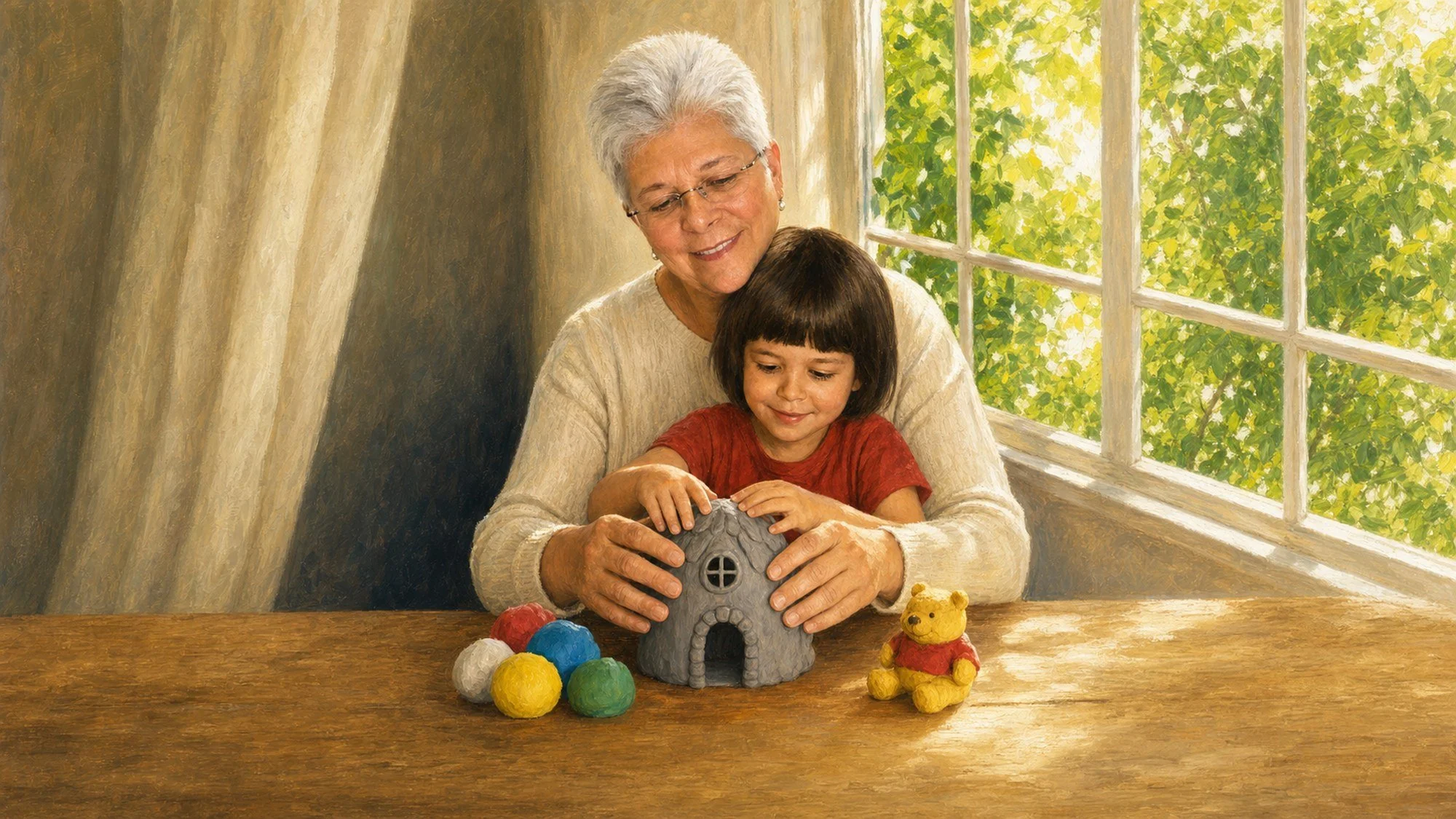
I had finally made time to create more beauty in my home. I started by making a fairy house for my garden. It also gave me time to reflect on things that interest me, and to follow a thread I'd been thinking about. I picked up the pen. I looked at the blank page.
Something else started happening.
Sometimes the words come out before I've decided what I'm going to say. There's something about holding a pen over a blank page. It doesn't require me to have everything figured out first. I can begin with one word, or simply let the pen move, and something begins to come through.
This time, what came through was a connection between creativity, being alone, being seen, and a part of my story I've carried for a long time.
As a child, I made Play-Doh figurines. It began with Winnie-the-Pooh.
I remember the feeling of the Play-Doh in my hands. At first it was a little cold. Then it warmed as I worked it. I rolled it into balls and shaped the round, chunky legs and big belly of Winnie-the-Pooh. I could stay with it for a long time.
When I think about that child making Winnie-the-Pooh, I feel calm. Very focused. Almost as though nothing else existed.
Yesterday, I found myself in that same kind of focus while kneading Apoxie Sculpt for my outdoor fairy house. I was pressing marks into the surface with a piece of petrified bark that looked a little like a small sword without a handle. I wet my fingers and worked the seams until they blended. I noticed how my fingers glided across the surface.
Then I noticed something else.
As a child, I didn't have language for what I was doing with Play-Doh. I only knew that I could sit down and make something. Today I can see that my hands may have been helping me calm myself — my body, my mind, my spirit. They helped me stay focused and feel the moment I was in. Maybe they helped me feel myself.
The connection I felt was seamless. It's kind of funny that I was blending seams.
When I was alone and creating, I felt connected to everything. I didn't always feel that connection when I was with people. Maybe that's why being alone with Play-Doh, and now with Apoxie Sculpt, has felt so important to me. My hands gave me a way to be here, and to feel connected when connection with people didn't come easily.
That realization led me toward something much later.
I had the language
My sister's death was a failure to rescue.
I was forty when she died. I was a nurse.
That's the part I keep returning to. I wasn't a child with no words for what was happening. I had the words. Failure to rescue is a nursing-sensitive indicator — a measure of what a system noticed, how quickly it acted on what it noticed, and what happened to the patient in the gap between the two. I knew what it meant. I knew what it was supposed to tell an organization about itself.
The day my mother called and told me to come to the hospital, I was driving there when I heard a voice say that I was going to be going to my sister's funeral. I was stopped at a red light. The sensation was strong enough that I opened the car door and was sick in the street.
I didn't know yet what had happened. My body did.
I've written about that drive elsewhere. What belongs here is what came after — because by the time I understood what I was standing in, I already had a name for it.
Knowing didn't protect me. If anything, it did the opposite. I could see the shape of what was happening while it was happening, and I couldn't stop it, and afterward I had a term precise enough to name it and nothing that could hold it. The language told me what went wrong. It had nothing to say about what to do with a person standing in that hallway who happened to be both the sister and the nurse.
I've thought a lot about what I actually needed that day, and it wasn't more accuracy.
I also think about my mother and the guilt she may have carried. I don't know everything she knew, what she was told, or what she was able to understand in the middle of that crisis. I can imagine fear, shock, grief, and perhaps guilt. I can hold that possibility without losing sight of what I needed.
I needed my tender heart to be held.
I needed someone to notice what I sensed and felt. I needed someone to say out loud that something overwhelming had happened, that being a nurse didn't mean I had to metabolize it professionally, and that I didn't have to carry it alone.
No one did. Not because they were cruel. Because there is no place in the workflow for that, and because a nurse standing in a hallway can look, to everyone passing, like someone who is handling it.
How I work now
I used to work inside the measure. I looked at failure to rescue the way it's meant to be looked at — as a signal about staffing, escalation, hierarchy, who felt able to speak and who didn't. That work was real, and I don't want to diminish it.
Now I work on the other side of the same measure.
I'm still interested in what a system notices and how fast it moves. But I'm equally interested in what happens to the people standing in the gap — the ones who sensed something and hesitated, the ones who were both the professional and the family, the ones a system counts as staff on a day when they are not only staff. An indicator can tell an organization that it missed something. It can't tell an organization what it costs a person to be the one who saw it.
I do this work because I've been on both sides of that number.
And when it got to be too much, I went back to my hands.
The thread
Writing this hasn't given me a neat answer. It has given me a thread.
The child who made things with Play-Doh, the woman who stood in a hospital hallway at forty knowing exactly what she was watching, and the one who now works with her hands — with clay, and with teams, and with the systems that decide what gets noticed — these don't feel like separate pieces of me.
They're the reason I don't walk into a room with a framework first. I walk in listening for what the room already knows and hasn't been able to say.
Maybe this is what integrating my DNA feels like: letting the pieces be connected without forcing them to make sense all at once.
Maybe the hands remember a way back to presence.
Maybe the blank page does too.
A note on Play-Doh. It has a Cincinnati connection. Before it became a children's modeling compound, it was made here as a wallpaper cleaner. In 1956, Rainbow Crafts Company repackaged and marketed it as Play-Doh to elementary schools in the greater Cincinnati area; by 1957 it was offered in red, yellow, and blue. Something so ordinary from childhood has a thread that reaches back to the place where I live. The Cincinnati origin is documented in the Play-Doh entry on Wikipedia and in reporting by The Cincinnati Enquirer.