Maybe the hands remember a way back to Presence
I sat down intending to write a blog post. What came through instead was a thread running from a child making Play-Doh figures, to my hands working clay on a table decades later, to a hospital hallway where I was forty, and a nurse, and already knew exactly what I was watching. This is what I found at the end of it…
I had finally made time to create more beauty in my home. I started by making a fairy house for my garden. It also gave me time to reflect on things that interest me, and to follow a thread I'd been thinking about. I picked up the pen. I looked at the blank page.
Something else started happening.
Sometimes the words come out before I've decided what I'm going to say. There's something about holding a pen over a blank page. It doesn't require me to have everything figured out first. I can begin with one word, or simply let the pen move, and something begins to come through.
This time, what came through was a connection between creativity, being alone, being seen, and a part of my story I've carried for a long time.
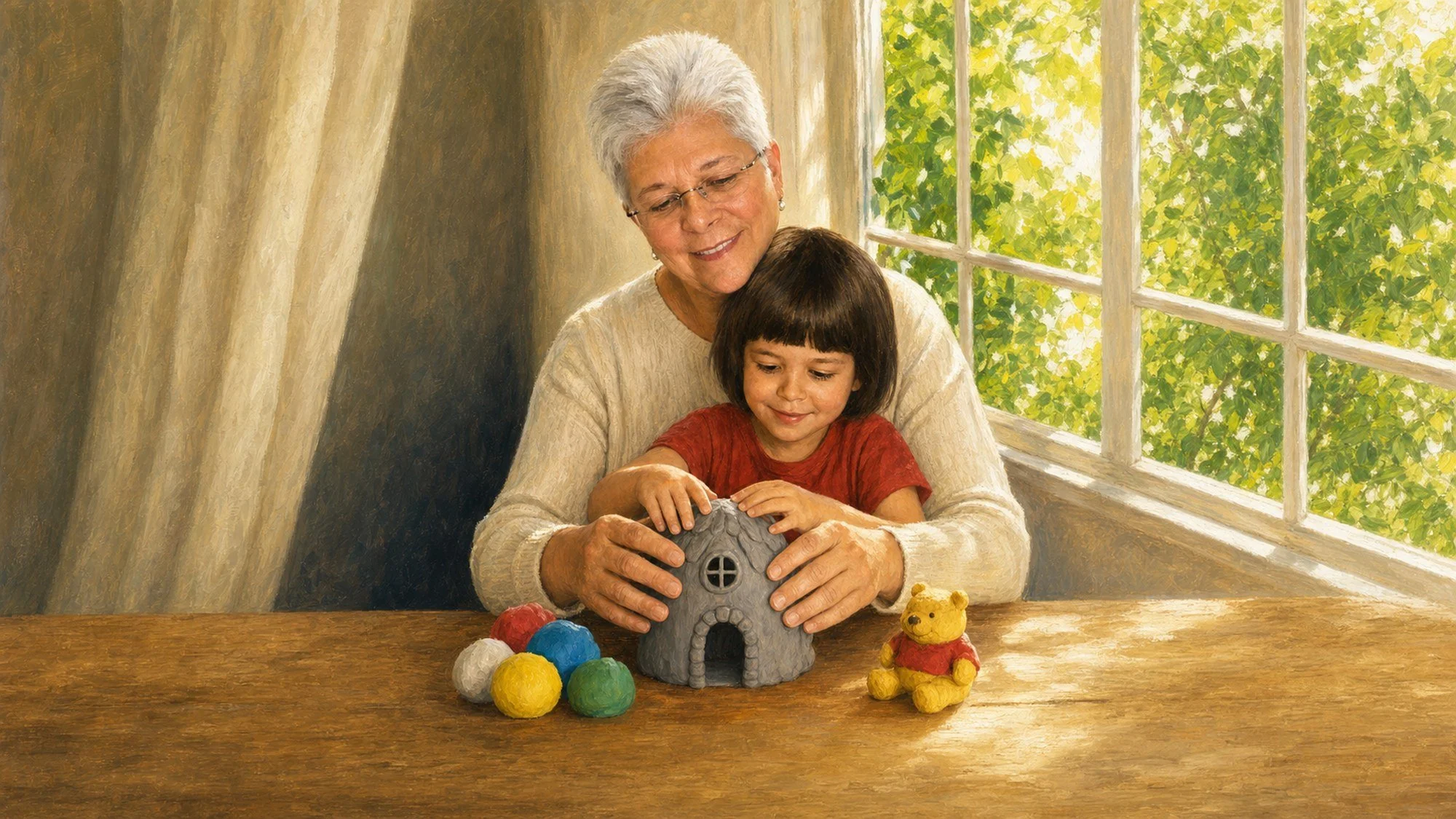
As a child, I made Play-Doh figurines. It began with Winnie-the-Pooh.
I remember the feeling of the Play-Doh in my hands. At first it was a little cold. Then it warmed as I worked it. I rolled it into balls and shaped the round, chunky legs and big belly of Winnie-the-Pooh. I could stay with it for a long time.
When I think about that child making Winnie-the-Pooh, I feel calm. Very focused. Almost as though nothing else existed.
Yesterday, I found myself in that same kind of focus while kneading Apoxie Sculpt for my outdoor fairy house. I was pressing marks into the surface with a piece of petrified bark that looked a little like a small sword without a handle. I wet my fingers and worked the seams until they blended. I noticed how my fingers glided across the surface.
Then I noticed something else.
As a child, I didn't have language for what I was doing with Play-Doh. I only knew that I could sit down and make something. Today I can see that my hands may have been helping me calm myself — my body, my mind, my spirit. They helped me stay focused and feel the moment I was in. Maybe they helped me feel myself.
The connection I felt was seamless. It's kind of funny that I was blending seams.
When I was alone and creating, I felt connected to everything. I didn't always feel that connection when I was with people. Maybe that's why being alone with Play-Doh, and now with Apoxie Sculpt, has felt so important to me. My hands gave me a way to be here, and to feel connected when connection with people didn't come easily.
That realization led me toward something much later.
I had the language
My sister's death was a failure to rescue.
I was forty when she died. I was a nurse.
That's the part I keep returning to. I wasn't a child with no words for what was happening. I had the words. Failure to rescue is a nursing-sensitive indicator — a measure of what a system noticed, how quickly it acted on what it noticed, and what happened to the patient in the gap between the two. I knew what it meant. I knew what it was supposed to tell an organization about itself.
The day my mother called and told me to come to the hospital, I was driving there when I heard a voice say that I was going to be going to my sister's funeral. I was stopped at a red light. The sensation was strong enough that I opened the car door and was sick in the street.
I didn't know yet what had happened. My body did.
I've written about that drive elsewhere. What belongs here is what came after — because by the time I understood what I was standing in, I already had a name for it.
Knowing didn't protect me. If anything, it did the opposite. I could see the shape of what was happening while it was happening, and I couldn't stop it, and afterward I had a term precise enough to name it and nothing that could hold it. The language told me what went wrong. It had nothing to say about what to do with a person standing in that hallway who happened to be both the sister and the nurse.
I've thought a lot about what I actually needed that day, and it wasn't more accuracy.
I also think about my mother and the guilt she may have carried. I don't know everything she knew, what she was told, or what she was able to understand in the middle of that crisis. I can imagine fear, shock, grief, and perhaps guilt. I can hold that possibility without losing sight of what I needed.
I needed my tender heart to be held.
I needed someone to notice what I sensed and felt. I needed someone to say out loud that something overwhelming had happened, that being a nurse didn't mean I had to metabolize it professionally, and that I didn't have to carry it alone.
No one did. Not because they were cruel. Because there is no place in the workflow for that, and because a nurse standing in a hallway can look, to everyone passing, like someone who is handling it.
How I work now
I used to work inside the measure. I looked at failure to rescue the way it's meant to be looked at — as a signal about staffing, escalation, hierarchy, who felt able to speak and who didn't. That work was real, and I don't want to diminish it.
Now I work on the other side of the same measure.
I'm still interested in what a system notices and how fast it moves. But I'm equally interested in what happens to the people standing in the gap — the ones who sensed something and hesitated, the ones who were both the professional and the family, the ones a system counts as staff on a day when they are not only staff. An indicator can tell an organization that it missed something. It can't tell an organization what it costs a person to be the one who saw it.
I do this work because I've been on both sides of that number.
And when it got to be too much, I went back to my hands.
The thread
Writing this hasn't given me a neat answer. It has given me a thread.
The child who made things with Play-Doh, the woman who stood in a hospital hallway at forty knowing exactly what she was watching, and the one who now works with her hands — with clay, and with teams, and with the systems that decide what gets noticed — these don't feel like separate pieces of me.
They're the reason I don't walk into a room with a framework first. I walk in listening for what the room already knows and hasn't been able to say.
Maybe this is what integrating my DNA feels like: letting the pieces be connected without forcing them to make sense all at once.
Maybe the hands remember a way back to presence.
Maybe the blank page does too.
Keep reading More reflections:
If you want the theory without the story:
A note on Play-Doh. It has a Cincinnati connection. Before it became a children's modeling compound, it was made here as a wallpaper cleaner. In 1956, Rainbow Crafts Company repackaged and marketed it as Play-Doh to elementary schools in the greater Cincinnati area; by 1957 it was offered in red, yellow, and blue. Something so ordinary from childhood has a thread that reaches back to the place where I live. The Cincinnati origin is documented in the Play-Doh entry on Wikipedia and in reporting by The Cincinnati Enquirer.
The Threshold Between What Was and What Comes Next
A reflection of being brought to a threshold between what was familiar and what is not yet fully formed. This reflection holds grief, relief, voice, accountability, and the next honest step toward creating more room for dignity, listening, partnership, and meaningful change in healthcare
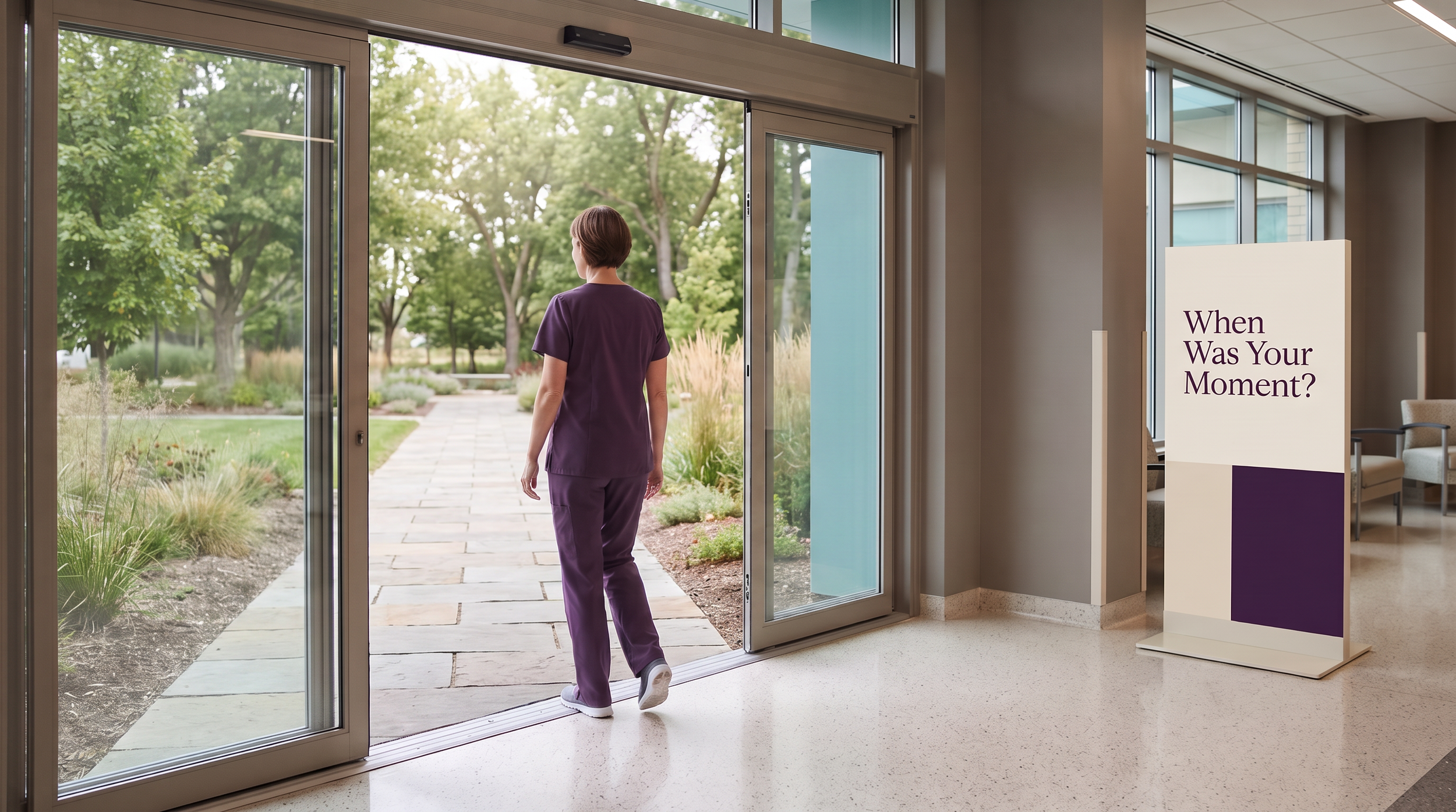
A reflection on professional endings, mixed emotions, and taking the next honest step.
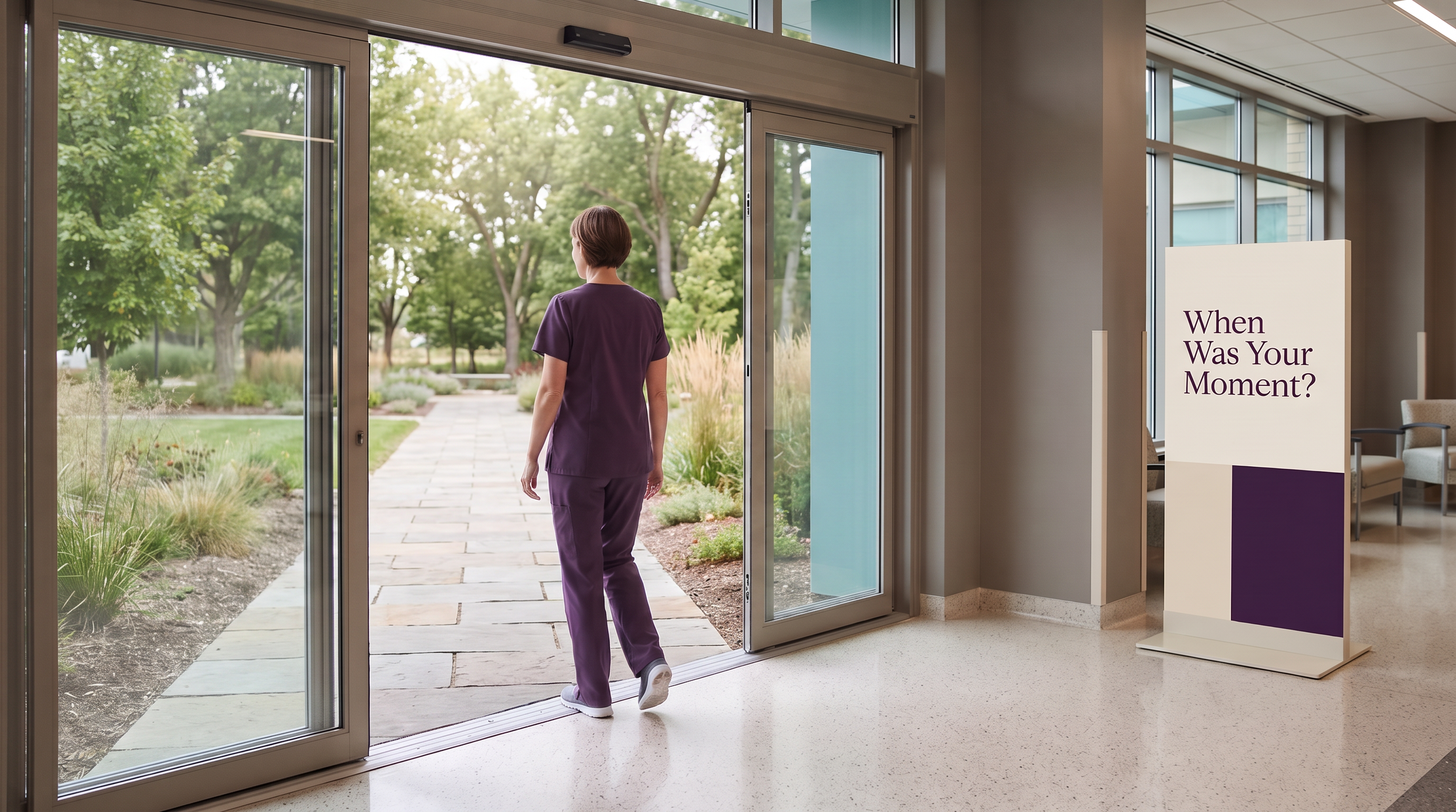
A recent professional transition has brought me to a threshold: the space between what was familiar and what is not yet fully formed.
I have been surprised by how many emotions can exist in the same moment. I have felt sad, because I cared deeply about the people and the organization involved. I have felt grief for the work, the relationships, and the possibilities that mattered to me. And I have also felt something I did not expect: relief.
I noticed that relief as I walked across the threshold and out of the building. It did not erase the sadness. It told me that some part of me had been carrying even more than I had fully realized.
I felt the need for something to change for some time. I had a voice, though I was still learning how to name what mattered—and there was not enough room for it to be fully heard. Through my ongoing learning from Thomas Hübl’s work, I have come to understand that making room is not only an inner practice. It is also something we create together: enough space within ourselves to stay present, and enough space between us for what is true to be heard and responded to.
Hübl’s work invites attention to the ways personal experience, family and ancestral histories, and collective or institutional patterns may shape what becomes difficult to feel, say, hear, or address. When painful experience remains unacknowledged, it may contribute to disconnection, reactivity, silence, or repeated patterns in relationships and groups. I hold this as an invitation to humility and inquiry—not as a way to explain anyone else’s experience, assign trauma, or reduce complex workplace dynamics to one cause.
In that sense, “making room” means slowing down enough to notice what may be present in us and between us: the habits, assumptions, loyalties, fears, histories, and unfinished experiences that can narrow our capacity to listen. It also means pairing truth-telling with practical conditions—clear decision rights, sufficient time, responsive leadership, and meaningful follow-through—so that people are not asked simply to disclose more in systems that are not prepared to respond.
For a long time, I have felt drawn toward work that creates more room for listening, partnership, and meaningful change in healthcare. I have been building IntegratingDNA Learning Partners on and off for many years, alongside other professional commitments. I often told myself I would give it more attention when there was more time, more certainty, or a clearer sign that it was safe to do so.
But perhaps there is never a moment that feels entirely safe.
I stayed because I cared. I believed in the people, the purpose, and the possibility of contributing something useful. I also stayed because I was not yet ready to fully trust myself with the work I have long wanted to do. There is no shame in that. Care, responsibility, loyalty, and fear can all be present at the same time.
Still, I can see now that waiting too long to make a needed change can have a cost. When we do not make space for what is asking to be acknowledged, frustration can begin to speak for the truth we have not yet found words for.
I wish I had responded with more composure at times. Not because my feelings were wrong, and not because I believe people should be expected to remain untouched by difficult circumstances. I simply want to be honest about my part: I let frustration get ahead of the clearer, more grounded conversation I wish I had been able to have sooner.
That is a tender thing to admit.
I am also aware that I did not arrive at this threshold alone. I carry ancestry, family stories, professional formation, identities, and experiences of belonging and not belonging. These threads shape what safety, authority, loyalty, voice, and leaving can mean to me. They do not define anyone else’s story, but they remind me that people enter workplaces already in relationship with histories—personal, collective, cultural, and institutional—that deserve humility, care, and curiosity.
I am learning that accountability does not have to become self-punishment. I can reflect on what I would do differently while still treating myself with dignity. I can recognize that I was affected without deciding that being affected means I failed.
Professional endings are rarely just logistical. They can touch identity, relationships, confidence, belonging, and our sense of what we thought the future would hold. In healthcare and other caring professions, they can also carry the weight of work we poured ourselves into, people we hoped to support, and commitments we took seriously.
That is why humane transitions matter. Even when an organization faces a difficult decision, people deserve clarity, dignity, time, acknowledgment, choice where possible, and practical support. These are not extras. They are part of how we uphold trust and recognize the humanity of the people whose labor, judgment, and care have contributed to the work.
If you are standing at a threshold of your own, you do not have to rush to make an ending sound positive. Grief and relief can both be true. Caring about what is ending and recognizing that it may be time to move forward can both be true. You can wish you had done some things differently without making your worth conditional on having handled every moment perfectly.
As I look ahead, I feel a growing sense of blessings in the work of IntegratingDNA Learning Partners. What began as a thread I returned to, again and again, over many years is becoming a clearer commitment. I am grateful for the possibility of bringing this work forward with greater intention: creating space for nurses, leaders, and organizations to listen more deeply, recognize the conditions people may be carrying, and build practical pathways toward dignity, voice, partnership, and repair.
I do not take that possibility lightly. It feels both humbling and hopeful—a chance to offer what I have learned while continuing to learn alongside others.
I do not yet know every detail of what comes next. But I am choosing to meet this threshold with honesty, care, and a renewed willingness to make space for the work I have long felt called to do: supporting nurses, leaders, and healthcare organizations to create conditions where voice, dignity, learning, and meaningful partnership can take root.
For now, that is enough: to take the next honest step.